SEO
SEO Content
  Paid
Paid  Reputation
  Design &
  Digital
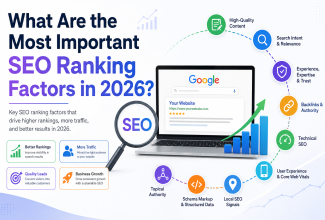
What Are the Most Important SEO Ranking Factors in 2026?
Search engine optimization has changed significantly over the years. In 2026, ranking on Google is no longer simply about adding keywords to a page or building as many backlinks as possible. Google’s search systems increasingly evaluate content quality, relevance, experience, technical performance, authority, user satisfaction, and overall website trust.
For businesses competing in organic search, understanding the most important SEO ranking factors in 2026 is essential. Search is also evolving with AI-powered results, changing user behavior, and increasingly sophisticated algorithms.
So, what actually matters for rankings in 2026?
Let’s look at the key SEO ranking factors that businesses and marketers should focus on.
1. High-Quality, Helpful Content
Content remains one of the most important foundations of SEO.
However, simply publishing a large number of articles is no longer an effective strategy. Google wants content that genuinely helps users accomplish what they came to search for.
High-quality content should:
- Clearly answer the user’s search query
- Demonstrate first-hand experience where appropriate
- Provide accurate and useful information
- Cover the topic comprehensively
- Be easy to read and navigate
- Avoid unnecessary repetition and filler
- Provide original insights, examples, data, or analysis
The goal should not be to write content solely for search engines. Instead, create content for the people using search engines.
2. Search Intent and Content Relevance
One of the most important SEO ranking factors in 2026 is how well your content satisfies search intent.
A keyword alone does not tell you exactly what the user wants.
For example, someone searching for:
“best CRM software”
is probably looking for comparisons and recommendations.
Someone searching for:
“what is CRM”
is looking for an explanation.
And someone searching for:
“Salesforce pricing”
may be looking for current pricing information.
Your content should match the intent behind the query.
Before creating a page, analyze the search results and understand whether Google is primarily showing informational articles, product pages, category pages, local results, comparison pages, or other content formats.
3. Demonstrated Experience, Expertise and Trust
Trust continues to be extremely important, particularly for topics that can significantly affect someone’s finances, health, safety, or important decisions.
Websites should make it clear:
- Who created the content
- Who operates the website
- What experience or expertise the author has
- Where information comes from
- How the content was researched
- When important information was last updated
For businesses, strong E-E-A-T signals can help establish credibility and differentiate your website from generic content.
Instead of simply claiming expertise, demonstrate it through real examples, case studies, original research, expert contributions, reviews, and useful resources.
4. Topical Authority
Google increasingly needs to understand the broader context of a website.
Publishing one article about a subject may not establish strong topical relevance. Building a collection of high-quality resources around a specific topic can demonstrate deeper coverage.
For example, a website targeting SEO services could create supporting content about:
- Technical SEO
- Local SEO
- On-page SEO
- Keyword research
- Link building
- SEO audits
- Google Search Console
- Core Web Vitals
- Schema markup
- Content optimization
- SEO reporting
These related pages can help build a strong topical ecosystem.
The objective isn’t to publish hundreds of thin articles. It is to build a useful knowledge base around your core topics.
5. Backlinks and Website Authority
Backlinks remain an important part of SEO in 2026.
However, the quality and relevance of links matter far more than simply counting backlinks.
A strong backlink is generally:
- From a trustworthy website
- Relevant to your industry or topic
- Editorially earned
- Contextually useful
- Connected to genuinely valuable content
For example, one relevant editorial link from a respected industry publication can be more valuable than dozens of unrelated or low-quality links.
Instead of focusing on “How many backlinks can we build?”, focus on:
“Why would another website want to reference our content?”
Original research, useful statistics, tools, studies, expert insights, and genuinely valuable resources can naturally attract links.
6. Technical SEO
Excellent content cannot perform at its full potential if search engines have difficulty crawling, rendering, or understanding your website.
Important technical SEO areas include:
- Crawlability
- Indexability
- XML sitemaps
- Robots.txt
- Canonical URLs
- HTTPS
- Structured data
- Mobile usability
- Internal linking
- JavaScript rendering
- URL structure
- Redirect management
- Duplicate content
- Page performance
Regular technical SEO audits can help identify problems that may prevent important pages from being properly discovered and indexed.
7. Core Web Vitals and Page Experience
Website performance continues to matter for both users and SEO.
Google’s Core Web Vitals focus on important aspects of page experience, including:
- Largest Contentful Paint (LCP) — loading performance
- Interaction to Next Paint (INP) — responsiveness
- Cumulative Layout Shift (CLS) — visual stability
A fast website provides a better experience, particularly on mobile devices and slower connections.
However, improving Core Web Vitals should not come at the expense of content quality. A fast page with poor or irrelevant content is unlikely to outperform a useful page simply because it loads faster.
8. Mobile-Friendly Website Experience
A large portion of web searches happen on mobile devices.
Your website should therefore provide a consistent and usable experience across smartphones, tablets, and desktops.
Pay attention to:
- Responsive design
- Font size
- Button and link usability
- Navigation
- Page loading speed
- Intrusive elements
- Mobile content visibility
- Forms and conversion paths
A website that works well on mobile is important not only for SEO but also for conversions and customer experience.
9. Internal Linking
Internal links are often overlooked, but they play an important role in helping search engines understand the structure and relationships between pages.
A good internal linking strategy can:
- Help search engines discover pages
- Distribute authority across your website
- Establish topical relationships
- Guide users to related information
- Support important commercial pages
For example, a blog about “Kitchen Remodeling Trends” could internally link to related pages about kitchen remodeling services, cabinet remodeling, remodeling costs, and design options.
Use descriptive, natural anchor text and link where it genuinely helps the reader.
10. Keyword Optimization
Keywords are still relevant, but modern SEO is much more sophisticated than simply repeating the target keyword.
Instead of keyword stuffing, optimize your content around:
- Primary keywords
- Related terms
- Questions users ask
- Entities
- Synonyms
- Subtopics
- Search intent
For example, a page targeting “SEO services” could naturally discuss SEO audits, technical optimization, keyword research, content strategy, local SEO, link building, and performance tracking.
The goal is to demonstrate relevance—not to achieve a particular keyword density.
11. Structured Data and Schema Markup
Structured data helps search engines better understand the information contained on a webpage.
Depending on the type of website and content, relevant structured data can include:
- Article
- Breadcrumb
- Organization
- LocalBusiness
- Product
- Review
- Event
- FAQ
Schema markup itself should not be treated as a shortcut to higher rankings. Its primary purpose is to provide structured information that search engines can interpret and potentially use for eligible search features.
Always implement structured data according to Google’s guidelines and ensure that the marked-up information accurately represents the visible page content.
12. Freshness and Content Updates
For topics where information changes frequently, freshness can be important.
This is particularly relevant to:
- SEO
- Technology
- Finance
- Product pricing
- Regulations
- Software
- News
- Statistics
- Local business information
Updating an article doesn’t mean changing the publication date just to make it look new.
A meaningful update should involve improving the content, correcting outdated information, adding new data, replacing obsolete examples, and addressing new developments.
13. User Satisfaction
Search engines ultimately want users to find useful answers.
This means website owners should look beyond rankings and traffic and consider whether visitors actually accomplish what they came to do.
Useful signals to monitor include:
- Organic conversions
- Engagement
- Returning visitors
- Page-level performance
- Form submissions
- Calls
- Purchases
- Content engagement
- Search queries generating traffic
Don’t optimize simply for clicks. Optimize for satisfied users and business outcomes.
14. Brand Recognition and Search Demand
A strong brand can support long-term organic visibility.
When users search specifically for your company, products, services, or expertise, your brand becomes part of your broader search presence.
Businesses can strengthen their brand through:
- Consistent publishing
- Digital PR
- Industry contributions
- Social media
- Customer reviews
- Expert content
- Original research
- Community participation
- Brand mentions
SEO should therefore be viewed as part of a broader digital marketing strategy rather than an isolated activity.
15. Local SEO Signals
For businesses serving specific locations, local SEO remains critical.
Important local SEO areas include:
- Google Business Profile
- Accurate business information
- Reviews
- Local citations
- Location-specific content
- Local backlinks
- Consistent NAP information
- Relevant local landing pages
For example, a digital marketing agency targeting multiple cities may create useful location pages such as SEO Services in Haridwar, SEO Services in Dehradun, and SEO Services in Rishikesh.
However, these pages should provide genuinely useful local information rather than simply replacing the city name on identical pages.
16. AI Search and Search Experience Optimization
One of the biggest changes in modern search is the growing presence of AI-generated search experiences.
Users may increasingly receive synthesized answers before clicking traditional organic results.
This creates a new challenge for publishers: being visible not only in traditional blue links but also across evolving search experiences.
To improve your chances of being understood and referenced, focus on:
- Clear factual answers
- Strong topical authority
- Original information
- Credible sources
- Structured content
- Expert insights
- Well-organized pages
- Unique data and research
Traditional SEO is not disappearing. It is becoming part of a broader search visibility strategy.
17. Originality and First-Hand Information
As AI makes it easier to produce large volumes of generic content, original information becomes increasingly valuable.
Consider adding:
- Original research
- Surveys
- Case studies
- Customer experiences
- Expert interviews
- Real screenshots
- First-hand testing
- Proprietary data
- Industry statistics
For example, instead of publishing another generic article about Google Ads, an agency could publish a case study showing how a specific campaign performed, what was changed, and what results were achieved.
That type of content offers something that generic AI-generated articles cannot easily replicate.
18. Website Security
HTTPS is now a basic expectation for websites.
A secure website helps protect users and their data and provides a more trustworthy browsing experience.
Businesses should also maintain:
- Valid SSL/TLS configuration
- Secure forms
- Updated CMS and plugins
- Strong authentication
- Malware monitoring
- Regular backups
Security is not simply an SEO tactic—it is fundamental website hygiene.
SEO Ranking Factors in 2026: What Should You Prioritize?
Not every ranking factor deserves equal attention.
For most websites, the following priorities provide a strong foundation:
| Priority | SEO Area | Importance |
|---|---|---|
| 1 | Helpful, high-quality content | Very High |
| 2 | Search intent & relevance | Very High |
| 3 | E-E-A-T & trust | Very High |
| 4 | Topical authority | High |
| 5 | Quality backlinks | High |
| 6 | Technical SEO | High |
| 7 | Internal linking | High |
| 8 | User experience & performance | High |
| 9 | Original research & experience | High |
| 10 | Local SEO, where applicable | High |
| 11 | Structured data | Medium |
| 12 | Content freshness | Medium–High |
The exact importance of each factor will vary depending on the query, industry, competition, and type of website.
What Doesn’t Work as Well in SEO Anymore?
Modern SEO requires moving away from outdated tactics such as:
- Keyword stuffing
- Buying large quantities of low-quality backlinks
- Publishing hundreds of generic AI articles
- Creating thin location pages
- Copying competitor content
- Manipulating reviews
- Creating content purely for search engines
- Obsessing over keyword density
- Publishing content without understanding search intent
These approaches may create short-term activity, but they don’t necessarily create sustainable organic growth.
How to Build an SEO Strategy for 2026
A practical SEO strategy can be organized into five stages:
Step 1: Understand Your Audience
Identify what your customers search for, what problems they have, and what information they need before making a decision.
Step 2: Build Topic Clusters
Create authoritative content around your most important products, services, and topics.
Step 3: Improve Technical SEO
Make sure Google can efficiently crawl, understand, and index your website.
Step 4: Build Authority
Earn relevant backlinks, mentions, reviews, partnerships, and recognition within your industry.
Step 5: Measure Business Results
Track more than rankings. Monitor organic traffic, leads, calls, sales, conversions, and revenue.
Final Thoughts
The most important SEO ranking factors in 2026 are not about finding one secret algorithm trick. Successful SEO is about creating a website that is genuinely useful, technically accessible, trustworthy, authoritative, and aligned with what users are searching for.
High-quality content, search intent, topical authority, E-E-A-T, technical SEO, backlinks, user experience, original information, and brand credibility all contribute to a strong organic search presence.
As Google and AI-powered search continue to evolve, the businesses most likely to succeed will be those that focus less on manipulating rankings and more on becoming the best and most trustworthy result for their target audience.
SEO in 2026 is therefore not simply about ranking a webpage.
It is about building a website that deserves to rank.
More From Blog